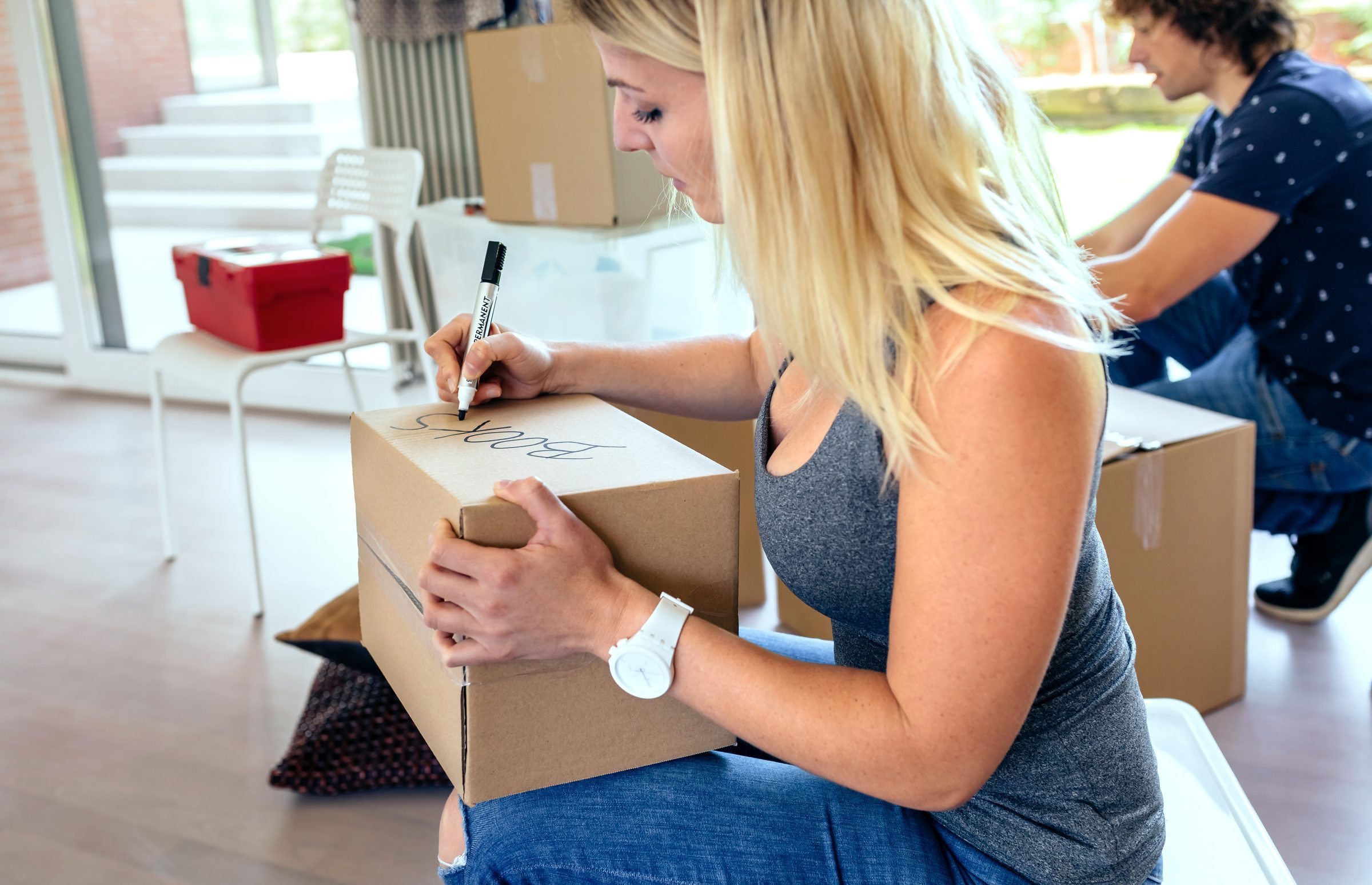
Write the destination room, a short contents list, and a box number on two vertical sides of every box, never on the top. Stacked in a truck, a label on the lid is a label nobody sees.
We run WeMove Pittsburgh as a family-owned crew of expert movers, so we've seen this one a lot. A well-labeled load unloads straight into the right rooms, instead of generating a question every third box.
Our moving company in Pittsburgh, PA, bills local work by the hour, so those questions have a price. You know, a few seconds with a marker saves a lot of standing around. Grab a thick marker before you seal the next box.
What Belongs on Every Box
Three pieces of information do almost all the work. The destination room comes before anything else. Write the room in the new house, not the room it came from, since those are often different. A short contents line follows, specific enough to be useful and short enough to read from six feet away.
"Kitchen, everyday plates and bowls" beats "kitchen stuff" by a wide margin. The third piece is a number, and it is the one most people skip. Number every box and keep a running list on your phone, or tack it onto your ultimate moving checklist. That is the only way to notice box 34 is missing before the truck pulls away.
It also lets you write less on the box itself, because the detail lives in the list. Write the number large and circle it. On a long distance job, that same list is what the load gets checked against at both ends.
Where to Write It So the Crew Can See It
Labels go on the sides and on at least two of them. Boxes sit stacked three and four high in a truck and against a wall at the other end. The top face spends the whole move hidden. Two adjacent sides cover you no matter which way a box ends up facing when it lands in a room.
Height matters as much as position. Write near the top edge of the side panel rather than the middle. The bottom half of most boxes sits behind whatever is stacked in front. Write the labels before the tape goes across the seam rather than after, so the marker sits flat on the cardboard.
Use a broad-tip permanent marker in black, and go bigger than feels necessary. A crew reading labels at a walking pace in a dim stairwell will not squint at neat handwriting. If the writing is small, they ask you instead. And if packing sounds like a chore, packing services can handle the labeling too, which is kind of a nice shortcut.
Color Coding and Numbering, and When Each Earns Its Keep
Color coding is worth it when several people are carrying boxes, and not all of them know your house. Assign one color of packing tape per room and run a stripe across two sides of each box.
Tape a matching color key inside the front door of the new place. Anyone can then place a box correctly without reading a word, which matters most when friends and family are helping alongside a crew.
Numbering suits a different situation. Think long distance moves, a storage gap between homes, or a household with more boxes than anyone wants to count twice. Pair the number with a line on a spreadsheet or a notes app. You then have an inventory to check off at the door.
- Room name, written large and up top
- Contents in four or five words, not a full list
- A box number, circled, matched to a list you keep
- FRAGILE on all four sides when it applies, plus an arrow showing which way is up
- OPEN TONIGHT on the two or three boxes you need that night
Both systems work. Running both at once on a small local move is more admin than it saves. Pick the one that fits the move you are actually making. Either way, labels only help if the packing underneath them is sound.
Not sure which labeling system fits your move? Give us a call at (412) 838-4495, and we'll help you pick one before you start packing.
Labeling Fragile and Heavy Boxes
FRAGILE means nothing when it is written once on one side in ballpoint. Write it on all four sides and add an arrow for the upright direction. Put it only on boxes that need the care, because a load where every box says "fragile" tells the crew nothing. Dish boxes, glassware, lamps, framed art, and anything with a screen are the real candidates.
Weight deserves a note too. Marking HEAVY on a book box tells the crew to bring two hands and a dolly. That courtesy protects your box as much as their backs. Honestly, decluttering before a move means fewer of these to worry about in the first place.
How Good Labels Pay Off at the Pittsburgh End
The payoff lands at the new house, not the old one. Tape a printed sign on every door, using the same room names you wrote on the boxes. The crew then stops needing a guide. On a Mt. Lebanon two-story or a South Side row house, a box on the wrong floor gets carried twice.
The second trip is on your clock. Labels also change what you can hand off. Hire our labor-only crew by the hour to load a rental truck, and point at the door rather than direct each item. That is the version of moving day where the kitchen is unpacked by dinnertime instead of hunted through at ten at night.
Spend the extra fifteen seconds per box. It is the cheapest thing you will do all week. It is also the only prep step that keeps paying after the truck has gone.
Have questions about labeling your boxes, or just want to talk through your move first? Contact us, and we'll help you figure out the right next step. You can also reach us at (412) 838-4495. We're here Monday to Sunday, 8:00 AM to 8:00 PM.